Icom IC-703
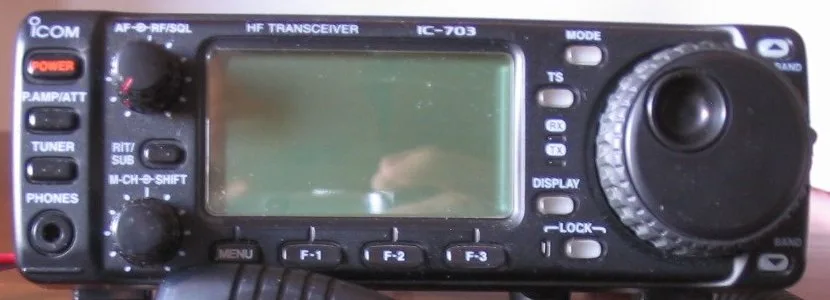
Icom’s 10 W QRP radio for HF (and 6 m on the Plus) with a built-in antenna tuner, low current drain and a 9–15.8 V supply range: the small 706-size body, built for portable, mountain-top and field operation.
Overview
The IC-703 arrived in 2002 as Icom’s low-power (QRP) portable radio. Its body is the same size as the 706 series (167 × 58 × 200 mm), but it weighs 2 kg and gives up to 10 W instead of 100 W. In return it runs on 9 to 15.8 V, draws little current on receive and, above all, has a built-in automatic antenna tuner, so a random wire or an imperfect dipole is enough to get on the air.
IC-703 or IC-703 Plus?
The Plus, released in 2003, adds 6 m. The first US-market IC-703s were HF only, while most European versions sold as IC-703 already had 6 m. Both panels just read “IC-703”; the surest test is whether 50 MHz can be selected. DSP (noise reduction and auto notch) is built in on some versions and needs the optional UT-106 on others.
Power and batteries
Above 11 V it gives 10 W. Below 11 V it switches to “battery mode” and limits power to 5 W (also 5 W at 9.6 V). That makes a 4-cell LiFePO4 battery (about 13 V) its best companion. With the backlight off and power saving on, receive current drops to about 0.3 A; transmitting at 10 W draws about 2.5–3 A.
Strengths
- Built-in automatic tuner for HF and 6 m; the ARRL lab saw it match loads up to about 8:1 SWR
- Low current drain and a wide voltage range, good for batteries and solar panels
- A receiver with better dynamic range than the 706 series (according to QST’s measurements)
- Good frequency stability thanks to a built-in TCXO (±0.5 ppm)
- Detachable panel, CW memory keyer, VOX, compressor and tone squelch
Weaknesses and common faults
- Only 10 W, which is little in poor conditions or for SSB pile-ups
- At 2 kg it is heavier than newer QRP radios for hiking and SOTA
- The CW keyer can lock up or send false elements from RF on the key line, especially with end-fed antennas; Icom issued a bulletin, and owners fix it with a ground wire from the key jack to the chassis
- On some early units the driver transistor failed because of incorrect bias
- Only one optional filter slot, and the microphone jack under the front panel is awkward
Portable tips
- Keep the supply above 11 V to keep 10 W; the 9.6 V BP-228 pack puts it in 5 W mode.
- The internal tuner is specified up to about 3:1 SWR on HF (2.5:1 on 6 m); never transmit without an antenna.
- The tuner remembers its settings per 100 kHz; enable PTT TUNE so it retunes when the frequency changes.
- In battery mode (below 11 V) the external AT-180 and AH-4 tuners do not work.
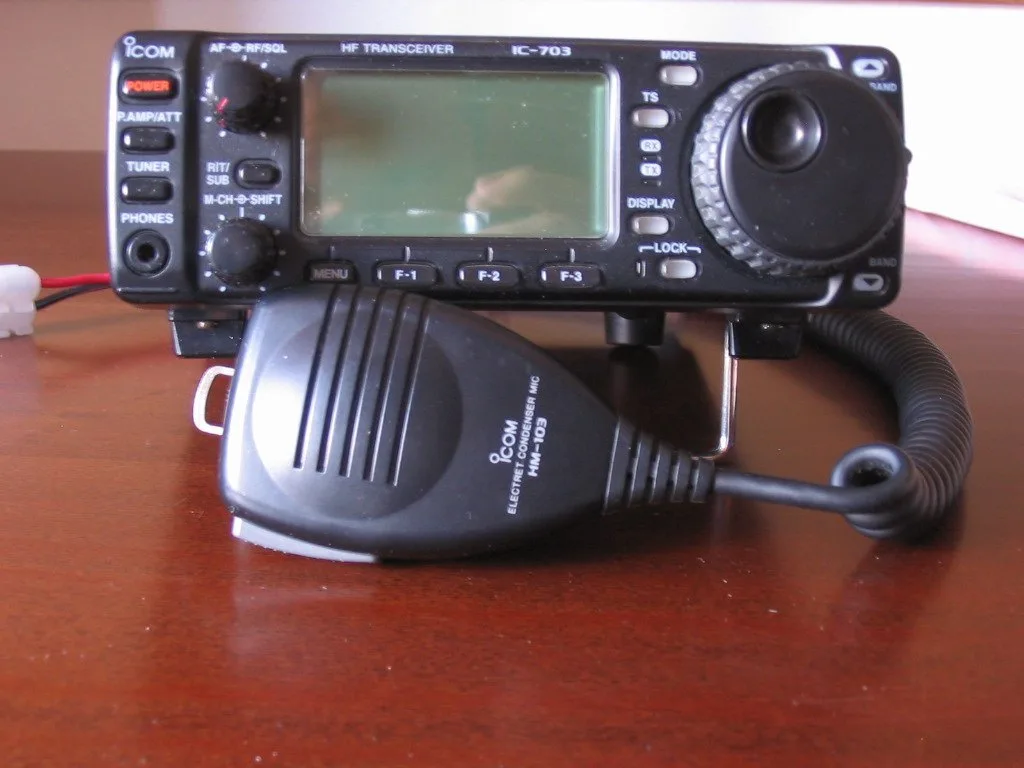
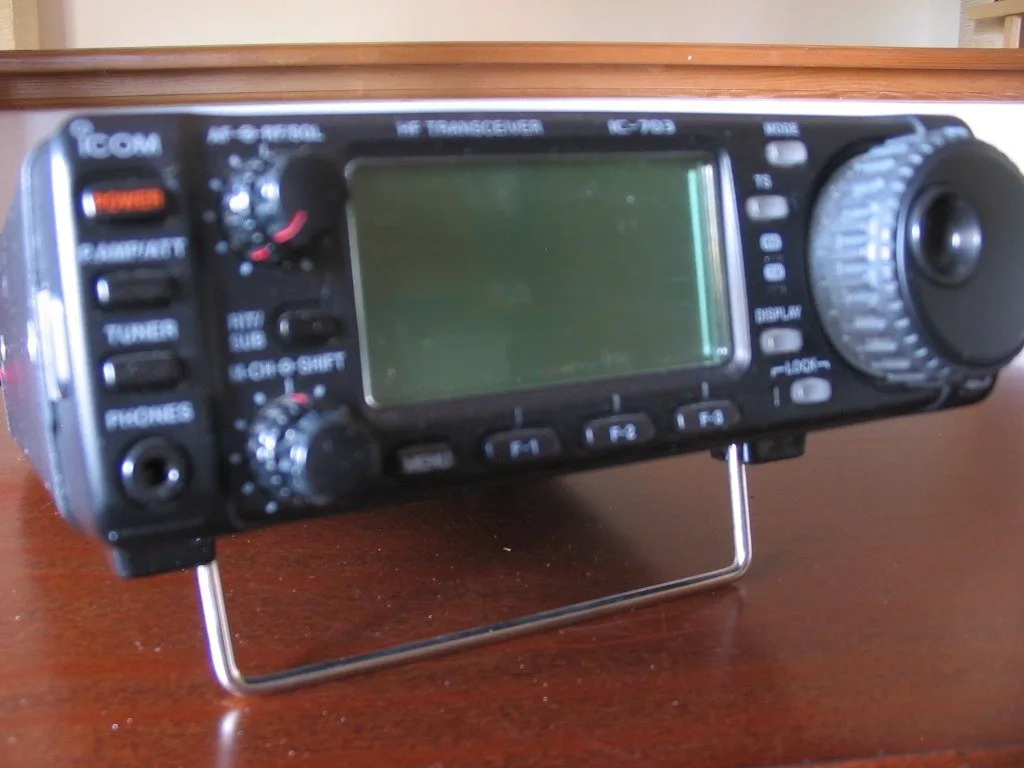
Photos: iz1ksw via Flickr, CC BY-SA 2.0 (cropped).
Specifications
- Introduced
- 2002 (Plus with 6 m from 2003)
- Transmit bands
- 160–10 m (all HF bands); 6 m on the Plus and most European versions
- Receive range
- 30 kHz – 60 MHz (depending on version)
- Output power, HF and 6 m
- 0.1–10 W at 13.8 V; 5 W max below 11 V (AM: 4 W)
- Output power, 2 m
- No 2 m band
- Output power, 70 cm
- No 70 cm band
- Modes
- SSB, CW, AM, FM and RTTY
- DSP (noise reduction, auto notch)
- UT-106 (NR and ANF); built in on some versions, optional on others
- Tone squelch (CTCSS)
- Built-in encoder and decoder, with tone scan
- Memory channels
- 105 (99 regular + 6 scan edges)
- Receiver
- Double-conversion superheterodyne
- IF frequencies
- 64.455 MHz and 455 kHz
- SSB sensitivity (preamp on)
- HF: 0.16 — 10 m: 0.13 µV
- FM sensitivity on 6 m
- 0.25 µV (12 dB SINAD)
- Frequency stability
- ±0.5 ppm (built-in TCXO)
- Power supply
- 9–15.87 V DC, negative ground
- Current drain
- Transmit: about 2.5–3 A (10 W) — receive: 0.3–1.2 A
- Antenna connectors
- One SO-239 (50 Ω)
- Dimensions (without projections)
- 167 × 58 × 200 mm
- Weight
- 2 kg
- Operating temperature
- −10 °C to +60 °C
- Automatic antenna tuner
- Built in for HF and 6 m (16.7–150 Ω); external AH-4 and AT-180 supported
- Optional filters
- FL-52A, FL-53A, FL-222 and FL-257 (one at a time)
- Separation cable
- OPC-581 (3.5 m) and OPC-587 (5 m)
- Optional battery
- BP-228 (9.6 V Ni-Cd, 2800 mAh)
Photos
Buying used: what to check
- 01 Check whether 50 MHz can be selected; that tells you whether it is a Plus or a European version with 6 m. Both panels just read “IC-703”.
- 02 With a 13.8 V supply and a dummy load, check for 10 W on several bands; low or no power can point to a failed driver transistor.
- 03 Try the internal tuner on a mismatched antenna or a wire and see that it tunes quickly.
- 04 If you work CW, try the keyer with an end-fed antenna; a locking keyer is the known RF problem.
- 05 Find DSP (NR and ANF) in the menu to confirm the DSP unit is fitted.
- 06 The BP-228 pack that comes with old units is usually worn out; do not count it in the price.
FAQ
What is the difference between the IC-703 and the IC-703 Plus?
Which battery should I use?
Which antennas can the internal tuner match?
Does it work on 2 m?
Questions about the IC-703?
Ask on Telegram or by email — common questions are added to this page.