Icom IC-706MKIIG
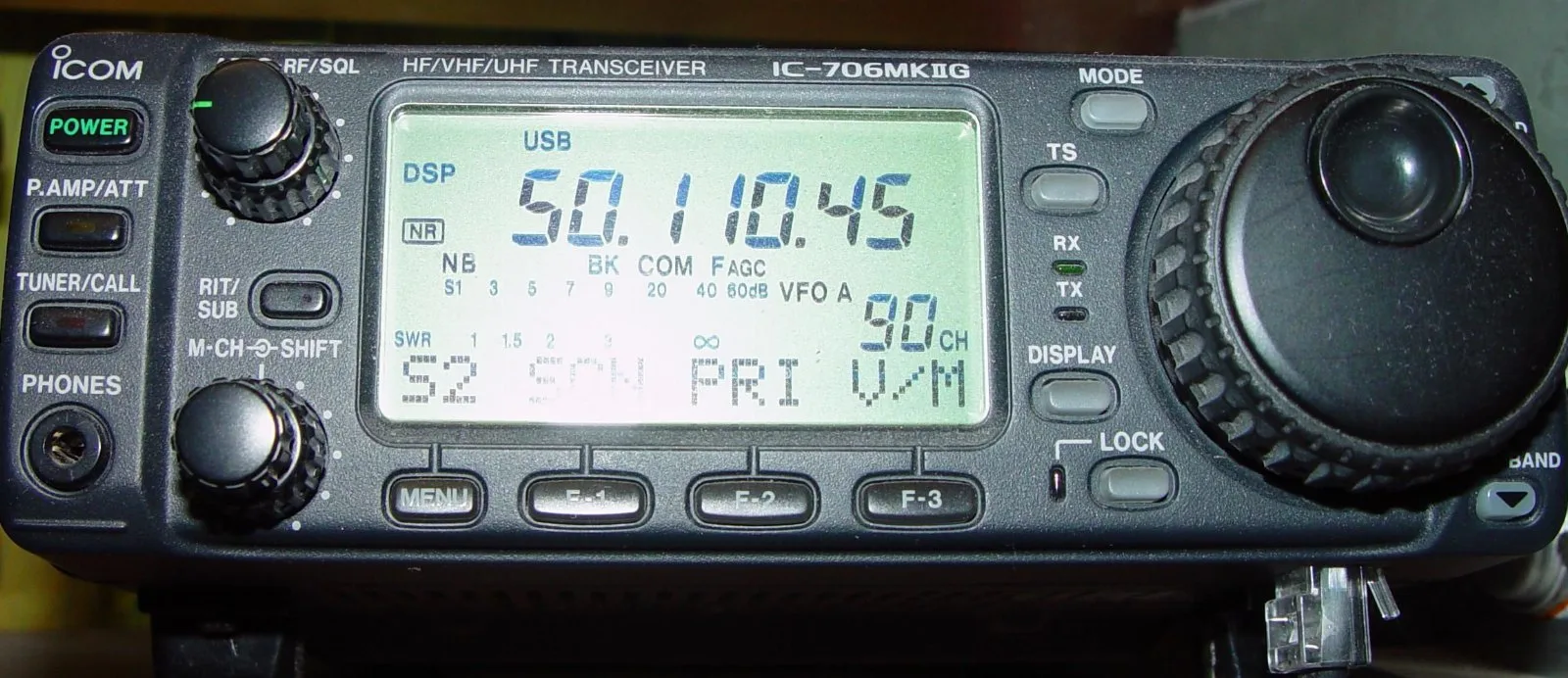
The most popular member of Icom’s 706 series (1999 to around 2009): 160 m to 70 cm in one small box — 100 W on HF and 6 m, 50 W on 2 m and 20 W on 70 cm, with built-in DSP and tone squelch.
Overview
The IC-706MKIIG arrived in 1999 and stayed in production for about ten years until the IC-7100 replaced it. The “G” means 70 cm was added: it covers 160 m to 70 cm in the same small 167 × 58 × 200 mm body, which made it one of the best-selling all-band radios in the world for years.
Compared with the IC-706MKII it brings three big changes: the 70 cm band with 20 W, 50 W on 2 m (instead of 20 W), and DSP noise reduction (NR) and automatic notch (ANF). CTCSS tone squelch, tone scan and auto-repeater are built in, so no extra unit is needed for FM repeaters. HF and 6 m power is still 100 W.
Who is it for?
Anyone who wants HF plus local 2 m and 70 cm repeater work from one radio, at home or in the car. Its size also makes it a favourite for portable and field operation (see the full comparison with the IC-706MKII).
Strengths
- HF, 6 m, 2 m and 70 cm in one small radio with a detachable panel
- Built-in DSP noise reduction and auto notch (on most versions; optional on some export versions)
- Tone squelch, tone scan and auto-repeater for repeater work
- 107 memory channels with 9-character names
- Works with the external AH-4 tuner for wire antennas on HF and 6 m
Weaknesses and common faults
- Runs hot on long FM transmissions, and the menus can confuse newcomers
- The DSP is weaker than on modern radios
- Instability on 15 and 17 m when the SWR is above 2:1; Icom Service Bulletin #928 covers the fix (soldering a ground spring on the filter board)
- Sudden shut-downs or no power-up; on some units glue under a board has corroded a copper trace
- Fuse holders in the power cable running hot, causing intermittent power
Installation and use
- 13.8 V with at least 20 A; never more than 16 V. The power cable fuses are 30 A.
- HF and 6 m antennas go to ANT1; 2 m and 70 cm to the second connector.
- Connect the AH-4 tuner to ANT1, use a wire longer than 7 m, ground it well and enable PTT TUNE in the menu. The AH-4 does not work on 2 m or 70 cm.
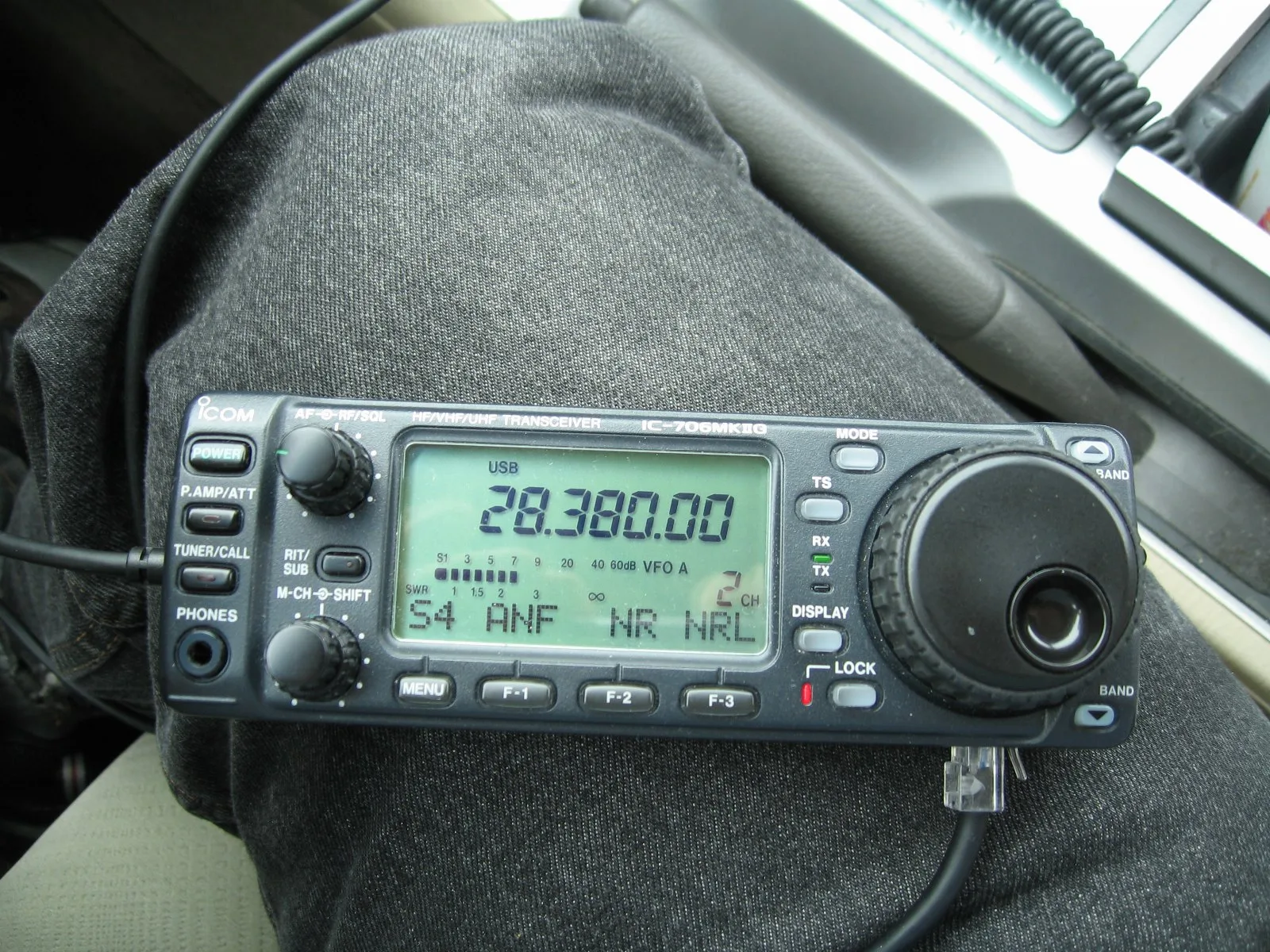
- In a car, run the power cable straight to the battery, keep the panel out of direct sun on the dashboard and switch the radio off while cranking.
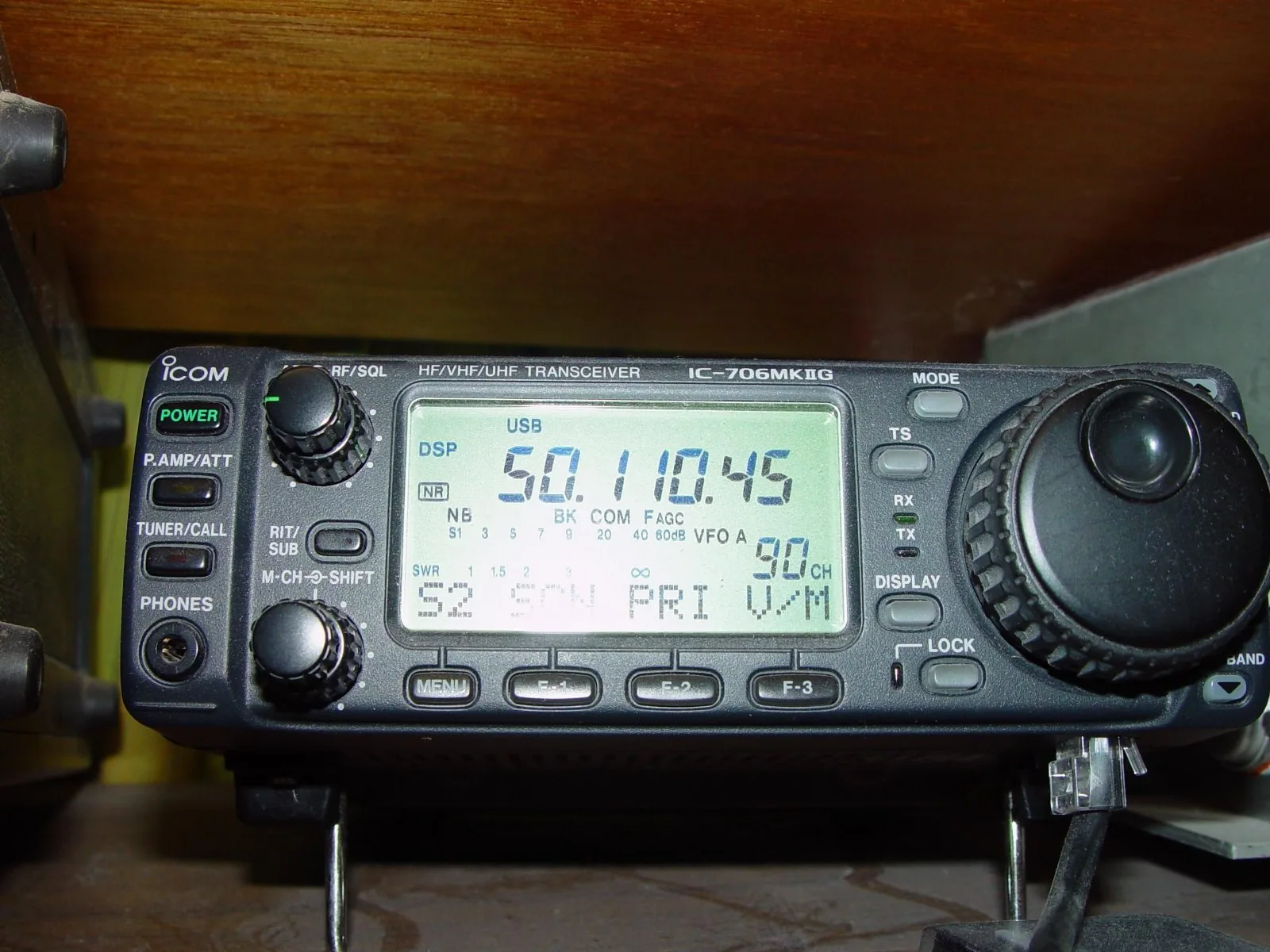
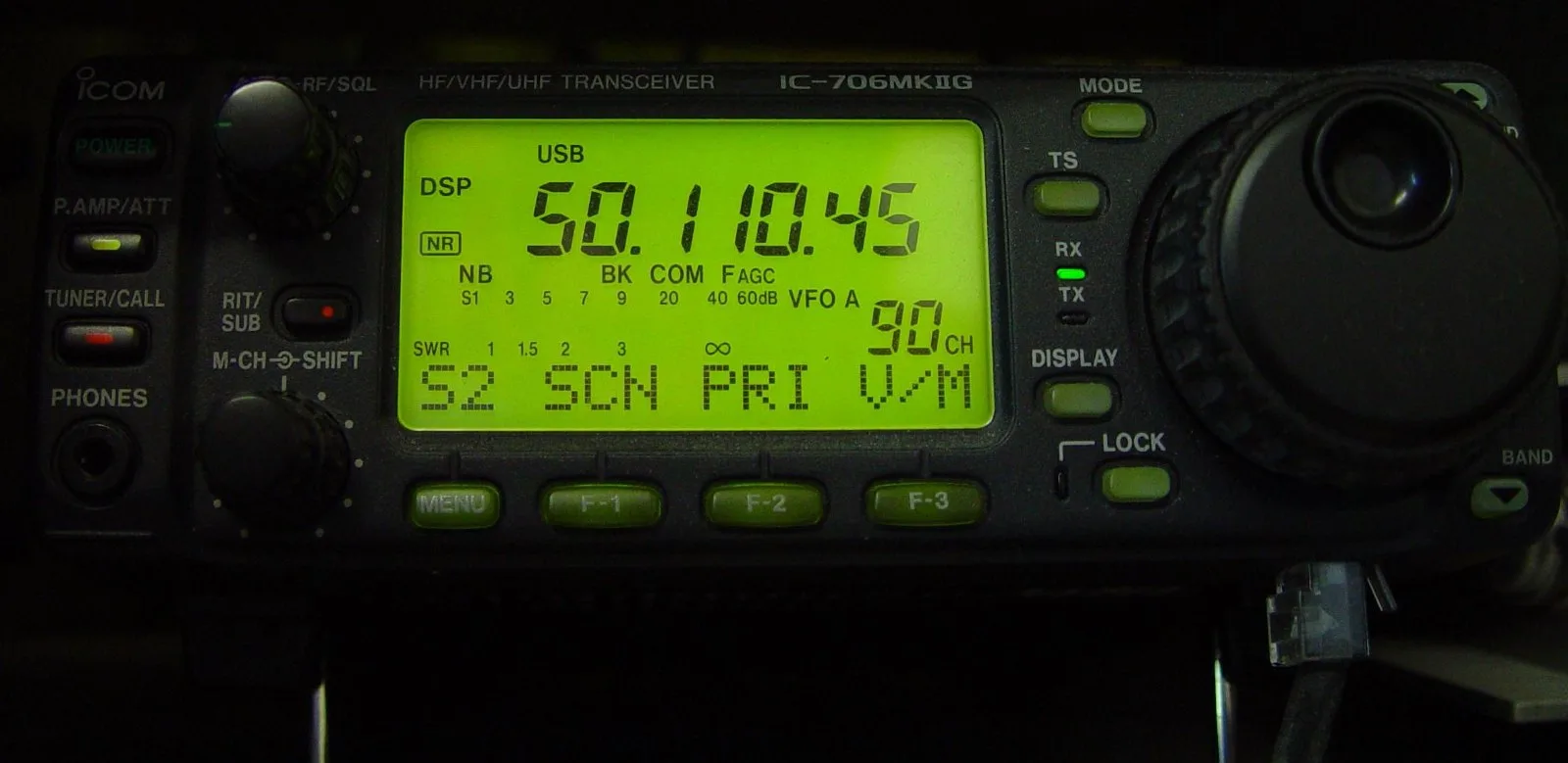
Photos: Leon Brooks (public domain) and Howard Brier (CC BY 2.0), via Wikimedia Commons.
Specifications
- Introduced
- 1999 (made until about 2009)
- Transmit bands
- 160–10 m (all HF bands), 6 m, 2 m and 70 cm
- Receive range
- 30 kHz – 200 MHz and 400–470 MHz
- Output power, HF and 6 m
- 5–100 W (AM: 2–40 W)
- Output power, 2 m
- 5–50 W (AM: 2–20 W)
- Output power, 70 cm
- 2–20 W (AM: 2–8 W)
- Modes
- SSB, CW, AM, FM, RTTY and WFM (receive only)
- DSP (noise reduction, auto notch)
- Built in (UT-106: NR and ANF); optional on some versions
- Tone squelch (CTCSS)
- Built-in encoder and decoder, with tone scan
- Memory channels
- 107 (99 regular + 6 scan edges + 2 call channels)
- Receiver
- Double-conversion superheterodyne (triple conversion on FM)
- IF frequencies
- 69.0115 MHz and 9.0115 MHz (plus 455 kHz on FM)
- SSB sensitivity (preamp on)
- HF: 0.15 — 6 m: 0.12 — 2 m and 70 cm: 0.11 µV
- FM sensitivity on 2 m
- 0.18 µV (12 dB SINAD); the same on 70 cm
- Frequency stability
- ±7 ppm; ±0.5 ppm with the optional CR-282
- Power supply
- 13.8 V DC (±15%), negative ground
- Current drain
- Transmit: 20 A max — receive: 1.8–2 A
- Antenna connectors
- Two SO-239: HF/6 m and 2 m/70 cm
- Dimensions (without projections)
- 167 × 58 × 200 mm
- Weight
- 2.45 kg
- Operating temperature
- −10 °C to +60 °C
- Automatic antenna tuner
- AT-180 or AH-4 (HF and 6 m only)
- Optional filters
- FL-100, FL-101, FL-103, FL-223 and FL-232 (two at a time)
- Separation cable
- OPC-581 (3.5 m) and OPC-587 (5 m)
Photos
Buying used: what to check
- 01 Make sure the panel reads “IC-706MKIIG” and that it transmits on 430 MHz; the MKII looks similar but has no 70 cm.
- 02 With a dummy load and wattmeter, check the power on HF (100 W), 2 m (50 W) and 70 cm (20 W).
- 03 Transmit on 15 and 17 m into a slightly high SWR; if the power or audio becomes unstable, the Service Bulletin #928 fix has not been done.
- 04 Switch it on and off a few times and tap the case; sudden shut-downs point to a corroded trace on the board.
- 05 Find and switch on the DSP functions (ANF and NR) in the menu to confirm the DSP unit is fitted.
- 06 Check the frequency accuracy on 2 m and 70 cm against another radio or a local repeater; used units are sometimes off frequency.
- 07 Inspect the ANT1 centre pin, the power cable fuse holders and the separation cable.
FAQ
What is the difference between the IC-706MKIIG and the IC-706MKII?
Is it suitable for 2 m and 70 cm repeaters?
Does the AH-4 tuner work with it?
What power supply does it need?
Which radio replaced the IC-706MKIIG?
Questions about the IC-706MKIIG?
Ask on Telegram or by email — common questions are added to this page.